Famous man’s-man director Howard Hawks was primarily a maker of “action” movies, but in the olden days of Hollywood the tag was a thoroughly respectable one implying no aspersion on the audience of such films. Some of the most admired directors of silents, Rex Ingram, and Sergei Eisenstein himself, were action directors. In the Thirties came Michael Curtiz and Raoul Walsh, both today considered master craftsmen of fast-paced adventures made with intelligence, imagination and spirit: in other words, more than Spielberg, Lucas or other of their ilk have ever achieved, and bearing hardly any relation at all to today’s blood-and-gore fests dished up as standard fare for desensitized ghouls who pass as film buffs.
Modern cineastes have concluded that Hawks’ particular schtick was the theme of male comaraderie, starting notably with Only Angels Have Wings (1939) most familiar to modern film fans. But by then he had produced all-time classics in several genres: the similarly pilot-concerned Dawn Patrol, Scarface, Road to Glory, and not least, screwball comedy in Bringing Up Baby and His Girl Friday to follow shortly after with Sergeant York, his third classic on World War I. He came late to westerns with 1948’s Red River but only John Ford’s are admired more, and just a few including Henry King are said to rank with Hawks as authentic interpreters of the American scene. Rio Bravo was remade with the same director-star combination into El Dorado (and certain refrains were replayed in Rio Lobo four years later). Superstar John Wayne was accompanied by Dean Martin in the first, Robert Mitchum in the second. The Duke is his Mount Rushmore self in both, each time a former hired gun turned lawman (the town sheriff in the first; allying himself with the town sheriff, an old friend, in the remake). And each story centers on him supporting his co-star in rehabilitating from town bumhood brought on by a no-good floozie. Making up the rest of the male ingroup are Ricky Nelson/James Caan on the youth side and Walter Brennan/Arthur Hunnicut as the curmudgeonly but humorously persnickety jailkeeper.
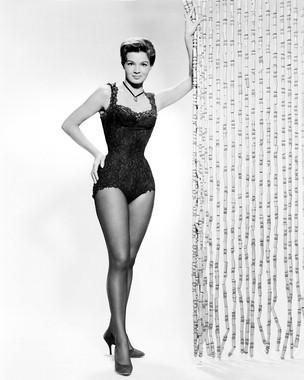
Angie Dickinson and that famous shape in costume for 'Rio Bravo', 1958
Hawks knew what he was doing in remaking it. There seems to be more happening, backed with a booming wall-to-wall Sixties soundtrack. It is in every way less sentimental than its Fifties forebear. The female roles are less defined in the remake (spread as they are now between Charlene Holt and Michele Carey), almost perfunctory compared with Angie Dickinson’s fully defined one, more in the nature of eye candy. That by itself says more about how spectacularly constructed female stars were treated in the Sixties. Raquel Welch hardly ever got a whiff of the central roles Sophia Loren had been entrusted with at an even younger age a decade earlier. And compare ingenue Natalie Wood with, say, the later Sandra Dee — typical Sixties teen fodder; and Tuesday Weld not allowed to show her talent until almost middle age. Dickinson plays a hard-drinking professional gambler turning back to saloon singing for new beau Duke’s sake, while in the Sixties version Duke comes across all bashful as an old-friend-of-the-family even responding to all-grown-up wholesome Charlene Holt, who has a scene sashaying around in a revealing figure-hugging number for no apparent reason but the aforementioned eye-candy factor.
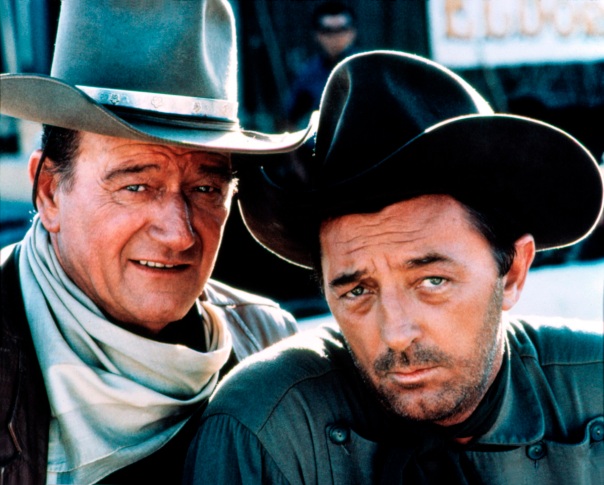
John Wayne and Robert Mitchum on the set of 'El Dorado', 1966

 Garbonza's Weblog
Is it required to attack the modern movie audience to validate your feelings on these classic westerns?
LikeLike
My first thought in reply was, no it’s not required but it makes writing a lot more enjoyable. And why not, in the same place, kill two birds with one stone? Actually, it is required. Not that it has anything to do with ‘validating my feelings’ — Is that what you do? I deal strictly in facts, and take my critic’s duty very seriously. It is simply a fact that the best early filmmakers came from the arts — painters, sculptors, writers, etc. Whereas the so-called best modern filmmakers are glorified computer nerds and rely more on technology to produce screen dramatics.
LikeLike
Cucial to the consideration of both movies is how they were influenced by the movie Hawks hated most: High Noon. I think Hawks is wrong about HN, which I think is a truly moving work, and more subtle than John Wayne would permit of his image.
But as far as the supposed conclusion of modern cineastes: that Hawks is a limited director of “male bonding” movies: the original Cahiers du Cinema crowd thought that Hawks was the most–varied?__director. As indeed he is.
LikeLike
Hey Dennis — Thanks for your comments. I knew that both Hawks and John Wayne were men’s men who hated ‘High Noon’. They certainly wanted to make a film that contrasted with ‘High Noon’. Wayne for one believed sheriffs and town’s marshals were ‘professionals’ who wouldn’t get all sweaty trying to persuade amateur townspeople to back them up when they might be more of a hindrance when it came down to it. Personally, I like ‘High Noon’ very much. It is moving, as you say. And I admire Fred Zinnemann’s approach to filmmaking in general. The only real reservations I have are:
1) The believability of the Grace Kelly character, who leaves Gary Cooper because he is going to use violence, then at the drop of a hat resiles from her lifetime belief and kills Frank Miller dead!
2) The MUCH-older-man syndrome, which in the Fifties was even more popular than today, apart from Clint Eastwood’s disparity with his leading ladies. Grace Kelly and Audrey Hepburn had to bear most of the burden, at one time or another between them being paired with Cooper, Gable, Crosby, Astaire, Stewart… all at least 20 years older than them, often nearly 30. Mostly, in their mid-twenties, they were coupled with men in their mid-fifties. Yucch! Even in ‘Roman Holiday’, supposedly featuring a young couple, Audrey Hepburn was 24 and Gregory Peck 37.
G. A.
LikeLike
What you consider faults in Rio Bravo is what makes the film so much fun to watch today. For me Brennan’s role is especially memorable. When they sing the song My rifle pony and me it sticks with me for most of that day afterwards. Rio Bravo is more humorous but it takes nothing away from he story. It adds to it. Some of the interactions between Wayne and Brennan still have me laughing today. Scenes with Wayne and some of the other characters are at times very funny. The cast is likable and user friendly. People remember the characters in Rio Bravo. Other than maybe a couple of the lead roles I’m not sure you can say that about El Dorado. Both have scenes that if you give them much thought you ask why they did it that way.?? For instance in RIo Bravo, why did Wayne And Martin continue to make their rounds in and around town with so many bad guys around? They could have easily been bushwhacked. Why did it take the bad guys so long to jump Dean, and Later Wayne is a bit perplexing. In El Dorado Mitchum was wounded in the movie but couldn’t seem to remember what leg he was wounded in. He would use the crutch in one arm and then the other. Continuity in El Dorado is poor, which always made me less of a fan. El Dorado is a much darker film. With Wayne being shot and in pain throughout much of the movie. Main characters being wounded, both end up on crutches. Its a much more violent film between the two. Wayne at times was vicious. I’m not sure which film is better. Both enjoyable for different reasons . Also both likable for one big reason, Wayne. I just know Rio Bravo goes down easier, and it’s less filling.
LikeLike
Howdy Pardner — love that name Johnny Wyoming. I assume we’re both pretty much fans of westerns. I even like sitting up past midnight to catch some Gene Autry or Ken Maynard on tv when I’m in the mood. So, I’m not arguing about what people like to watch or what they don’t like to watch. As a critic my job is to criticize things that are glaringly irritating to the drama on the screen — faults in the work of major filmmakers. A critic many years ago said that Walter Brennan won four Academy Awards from one performance — meaning he came over time to just walk through his roles on screen. In fact he made a whole “singing” and recording career out of his old codger’s voice — the one character he replayed over and over. I think I, as a customer, resent him just slipping on that comfortable cliche every time he was in front of a camera.
I watched John Ford’s “The Searchers” (1956) last night. It’s got some very heavy scenes and themes running all through it. Pain and the rest was all just everyday life in those days in the West, but in “The Searchers” it’s punctuated every now and again with unobtrusive, almost accidental humor in context. And done just right, like it’s fresh, by all the actors.
There is a definite “feel good” factor with “a likable and user-friendly cast” — otherwise I suppose Tom Cruise wouldn’t be so popular, despite everything. I guess when I’m looking at a serious western I wanted it treated seriously with actors fitting their roles like gloves. And when I’m looking at “The A Team” (1989), the comedy with Michael Keaton, Christopher Lloyd and so on, I want to see well-written and well-acted comedy with ideas in it too — not just huge boxoffice stars..
LikeLike
El Dorado, just cause. I’m was watching Rio Bravo and wondering if there was a “Verses” site. ED is a fun movie and RB is wooden. I just like sitting down and watching the movie. It feels right and I feel entertained. The holes in the movie are smoothed over and the violence is reasonable. I like the story line and feel satisfied when the movie is over. The Duke is the Duke in every movie though I think I liked his character the best in “She Wore a Yellow Ribbon”. Robert Mitchum is my believable favorite dunk sheriff although Dean does OK. Mitchum is just one of those all time favorite actors we will miss in the years to come. James Cann beats Ricky Nelson hands down and I like the humor and lightness he adds to the movie. If Ricky could act he might have a chance but he is too much pretty boy and besides he seems to spend all his time rolling cigarettes. I’ll take Arthur Hunnicut’s, Stumpy any day of the week (although it can get a bit old) vs. the way overdone Walter Brennan (as predictable as the Duke) we have seen so many times before. As for the women… ahhh, we all like to look at Angie but I never thought she could act worth a dime. Point goes to the simple role of, Charlene Holt. The relationships in ED between the people make sense. The humor and action keeps me involved. I will always go for El Dorado. Its a movie that makes me feel good.
LikeLike
Always thought ,a huge rip off good movies though,!
LikeLike
The scene with Mitchum finally getting his act together in the bar while cramping up makes El Dorado special
LikeLike
Yes, I hadn’t realised there was so much involved in that scene until you reminded me — the way Robert Mitchum does it makes it seem so effortless: a sign of why he was so admired by other professionals in Hollywood (not Katharine Hepburn, who insisted he was getting by on his looks), including Charles Laughton who directed him in “Night of the Hunter”. A friend of mine insists Mitchum is the same in every film — and I have to point out each and every portrayal to try and convince him otherwise. But it’s useless trying to convince those who will not see, who think Mitchum’s just being himself in every role — because you can’t see him acting from a mile away like their favorite classic English actors.
LikeLike
I’ve never minded any actor “being himself in every role.” I do admire the work of the gifted chameleons like Gary Oldman and Daniel Day Lewis, and who can deny that they are the most talented of actors? However, a star that shifts from film to film revising the same roles is a legitimate pleasure.
We don’t usually talk about it this way, but I think when we watch Brando in The Godfather, we’re partly watching Terry Malloy again. It’s why we love movie stars. Not, with few exceptions, because we expect them to go so far into their characters that we don’t recognize them. We WANT to recognize them.
Enjoyed your blog. I’m an El Dorado man myself, but I saw that one first, which always carries a litte weight.
LikeLike
Hiya Bub — If you’re referring to my remark about John Wayne being his usual “Mt Rushmore self” or words to that effect, I myself would find it hard to imagine anyone else in the role, and I think he does it particularly well in El Dorado. Yes, there’s a lot to be said for a star image and how it’s used by skilled directors for increased impact on the screen. I don’t mean to say there’s no pleasure in seeing him (or Walter Brennan) playing pretty much the same character repeatedly — but I, like many other critics, do especially admire it when Wayne stretches himself to include other characteristics such as his more demanding roles in Red River, The Searchers (both his most admired) and maybe to a lesser extent True Grit.
I’m not in favor of the chameleon approach because it tends to show unless the actor is absolutely gifted, as with Daniel Day Lewis as you say (haven’t seen much of Oldman). Saying this, I was surprised to see recently that the actor who plays lead in “Law & Order: Special Victims Unit” (can’t remember his name) is capable of greatly varied performances. I don’t know if he’s considered a virtuoso or not much more than pleasingly versatile, but I had mistakenly assumed he was a boring performer who never changed facial expression while in fact he plays the character as boringly unvarying for whatever reason. One comment from Bette Davis on studio mate Paul Muni, considered the great screen actor of his day, was to the effect that his chameleonlike transformations between roles robbed his performances of “flesh and blood” (I think was her phrase). In the old days so many admired actors relied on a rigid technique — seemingly judged on how big was their bag of tricks. Spencer Tracy once said that no matter how varied Laurence Olivier’s portrayals he was always aware it was just Larry.
These days I tend to trust the insight and sagacity of Robert Mitchum, a man, I think, not easy to fool. His reaction whenever he heard of someone described as “a great actor” was to just laugh — implying that he saw acting as nothing special, you could either do it or you couldn’t (allowing for a large range of how gifted at it individuals are), and that it didn’t rate anywhere near saving someone’s life for a living, researching cancer, etc, etc. And I tend to rate highly as people those stars who downplayed the importance of acting as a profession in relation to other callings — Brando, Tracy, Gable, Mitchum, and on and on… Maybe screen superstars such as Wayne (a thorough professional by all accounts), Gable, Frank Sinatra — Sinatra I find much more intriguing to watch than 99% of trained actors — were gifted in that they could intuitively “turn on” whatever facets of personality in the most suitable contexts that most of the audience would instinctively react to.
LikeLike
Rio Bravo is a remake of To Have and Have Not starring Humphrey Bogart and Lauren Bacall. El Dorado is not. Watch them back to back, dialogue and give and take is similar. Walter Brennan is in both. Try it see what you think.
LikeLike
Without watching them both again, I have to admit I can’t see this one Jackson. Maybe in a pinch I can see John Wayne playing a similar role to Bogie, but Dean Martin as Lauren Bacall? Well, at least they had the good judgment to delete the love scenes between the Duke and Dino… But seriously folks, Warners had a habit of recycling good and bad scripts alike so I wouldn’t be surprised if dialogue overlapped from one generation to the next. Indeed, Walter Brennan is in both and is playing the same toothless old codger he usually did.
LikeLike
[…] MOVIE REVIEW — HOWARD HAWKS: Rio Bravo (1958) vs El Dorado (1966) (garbonza.wordpress.com) […]
LikeLike